OUR TECHNOLOGIES
A new perspective.
Carried by light.
Understand the acoustic and thermal conditions along your infrastructure with distributed fiber optic sensing.
DISTRIBUTED SENSING, EXPLAINED
The fiber is
the sensing path.
An optical interrogator sends light into the fiber and analyses the light that returns.
Changes in that returned signal help reveal what is happening along the fiber route. The sensing technique determines which properties are measured and how the results can support your application.
DAS / SENSING TECHNOLOGY
Distributed Acoustic Sensing
Hear the events along your fiber.
DAS analyses changes in optical backscatter to measure dynamic strain associated with vibration and acoustic activity along the fiber. It can support the detection and location of disturbances when the sensing cable and processing are matched to the site.
- Pipeline and perimeter disturbances
- Rail and transport monitoring
- Geophysical and research applications

Technology at a glance
- Measurement focus
- Vibration and acoustic activity
- Sensing approach
- Optical backscatter analysis along the fiber
- Typical outputs
- Location-based signals, event data and alerts
- Design considerations
- Fiber coupling, bandwidth, spatial sampling and background noise
DTS / SENSING TECHNOLOGY
Distributed Temperature Sensing
Put temperature changes on the map.
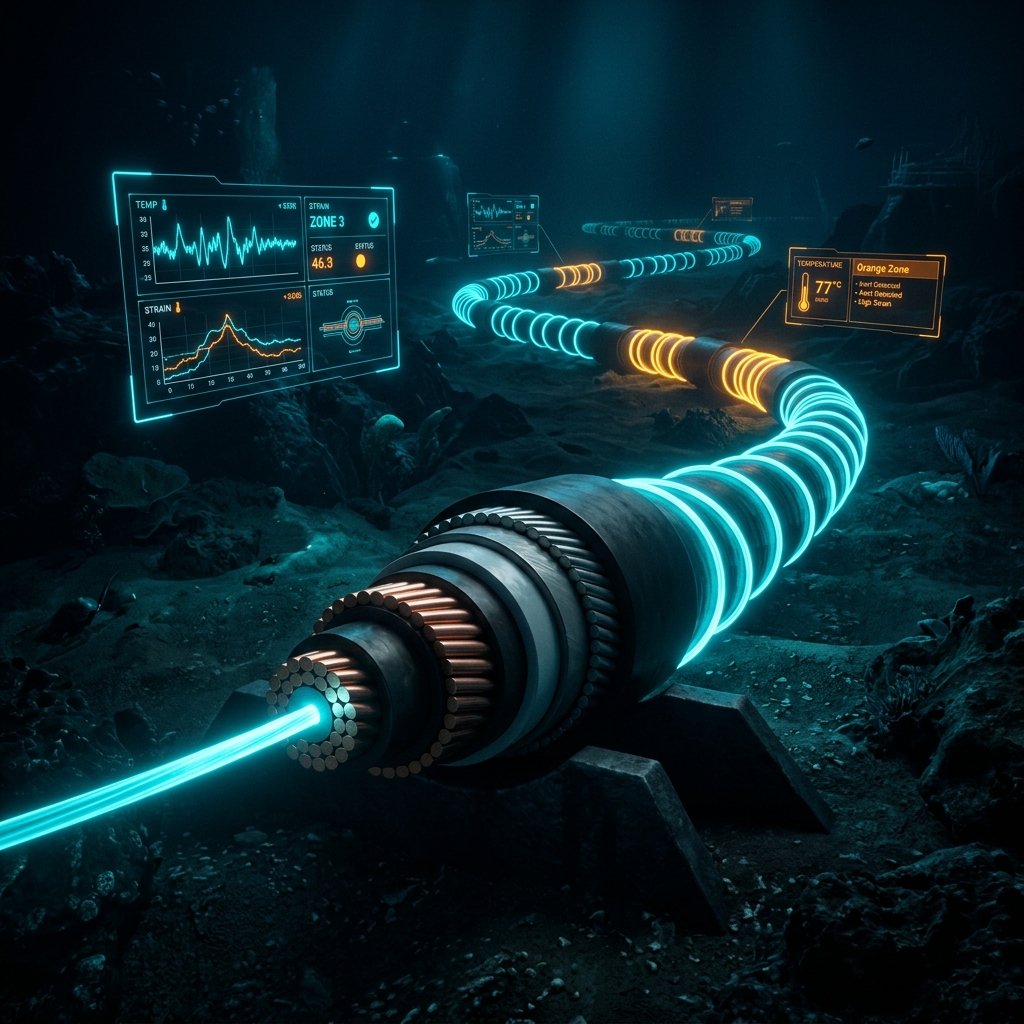
DTS uses temperature-dependent optical scattering to estimate temperature along a sensing fiber. Distributed thermal profiles help teams identify hot spots, compare conditions over time and investigate anomalies along monitored assets.
- Power cable thermal monitoring
- Pipeline and process temperature profiles
- Tunnel, facility and environmental monitoring
Technology at a glance
- Measurement focus
- Temperature along the fiber
- Sensing approach
- Temperature-dependent optical scattering
- Typical outputs
- Temperature profiles, trends and threshold alerts
- Design considerations
- Fiber type, measurement length, update time and thermal coupling
CHOOSING YOUR APPROACH
Match the measurement
to the question.
Range, resolution, accuracy and update rate depend on the selected instrument, fiber arrangement and site conditions. We review these together when developing your project requirements.
| Your monitoring question | Technology to explore | What it reveals |
|---|---|---|
| Where is unusual vibration occurring? | DAS | Acoustic activity and disturbance locations |
| Where are temperatures changing? | DTS | Thermal profiles and local temperature anomalies |
| Do I need acoustic and thermal context? | DAS + DTS assessment | Complementary measurements for the application |
LET’S BUILD SOMETHING THAT MATTERS
Let’s find the right
sensing approach.
Tell us what you need to monitor. We’ll help you explore the right sensing approach.